Mechanical Sonar Scanning Strategies for Fast Underwater Obstacle Detection on a Reef Surveying Autonomous Surface Vessel
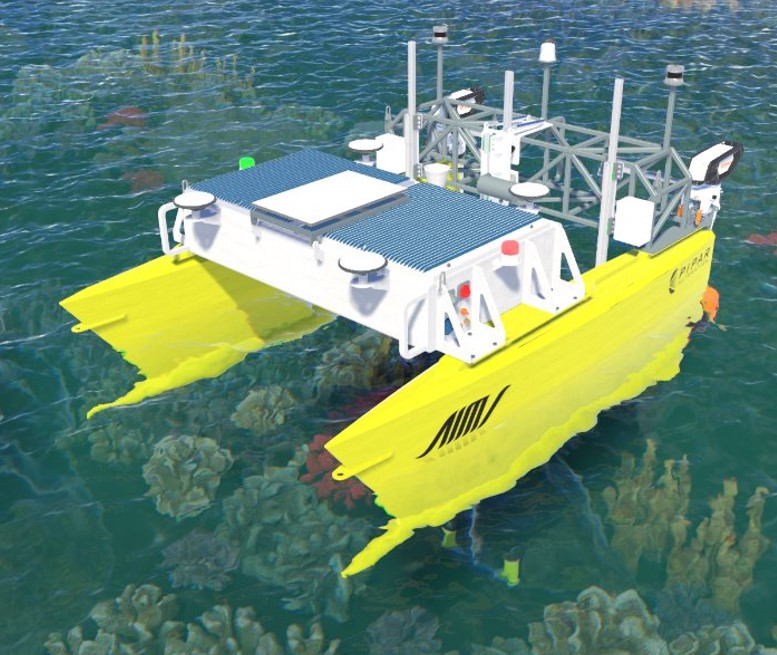
Coral reef surveys provide vital information about the health of these important ecosystems. Existing surveying methods are often manual and time-consuming operations that require teams of scientists to travel to remote locations for data collection. Instead, robotic automation can offer a more efficient and sustainable solution for continual reef monitoring. Autonomous surface vessels (ASVs) are able to navigate open waters using GPS and other onboard sensing capabilities. By virtue of having their communication array above the water, they are also able to send and receive data rapidly. In combination with a towed underwater sensor stack, such a platform has the ability to gather and transmit high resolution data collected close to the reef on demand. However, one challenge when working with a towed sensor stack is the added risk of collision with the terrain.
This project therefore developed sonar-based underwater obstacle detection and avoidance methods to enable the ASV to navigate over hazardous and unmapped reef terrain. Sonar is necessary for the underwater environment but has an imprecise propagation profile and very slow scanning speed. To provide the greatest time for replanning and collision avoidance, adaptive scanning strategies were designed, implemented and evaluated with results demonstrating the efficacy of the scanning techniques in terms of obstacle detection speed and path proximity to obstacles.
This project was conducted in collaboration with Pipar Automation.
Poster
🖼️ view the poster for Mechanical Sonar Scanning Strategies for Fast Underwater Obstacle Detection on a Reef Surveying Autonomous Surface Vessel!Prize Categories

Best Systems and Software Engineering Project
Technologies and Skills
- Robotics
- Sonar-based mapping
- Obstacle detection
- Collision avoidance